🇵🇪 Peru · Megalith
Cutimbo
Late Intermediate–Late Horizon Colla–Inca 1100–1532 CE · Colla (Qolla) and Inca
Second chullpa field after Sillustani: 120 towers 10 m on mesa with puma and monkey reliefs.
Search places, or jump to a section
🇵🇪 Peru · Megalith
Late Intermediate–Late Horizon Colla–Inca 1100–1532 CE · Colla (Qolla) and Inca
Second chullpa field after Sillustani: 120 towers 10 m on mesa with puma and monkey reliefs.
🇷🇺 Russia · Archaeological wonder
Early Scythian (~900–700 BCE) · Aldy-Bel / Arzhan (early Scythian–Siberian)
Enormous 120-m stone platform kurgan in the Uyuk depression, where archaeologists led by Gryaznov and later Chugunov uncovered a radial larch log mortuary house with central royal double burial and…
🇹🇯 Tajikistan · Ancient city
Afanasievo to Sarazm Chalcolithic–Bronze Age · Sarazm culture (Central Asian proto-Bactrian)
Earliest proto-urban centre in Central Asia (4000–2000 BCE) in Zarafshan Valley, Tajikistan's first UNESCO site (2010), 100 ha town with irrigation canals, palace, fortified citadel and aeolian…
🇹🇳 Tunisia · Ancient city
Punic / Roman / Byzantine (4th c BCE–7th c CE) · Punic / Roman
Roman–Punic oil port with amphitheatre and thermae on Gulf of Gabès.
🇵🇪 Peru · Temple complex
Inca Imperial 1450–1530 Neo-Inca to 1572 · Inca (Pachacuti? Topa Yupanqui)
Inca cloud-city with white stone llamas paving terraces above Apurimac canyon.
🇳🇬 Nigeria · Ancient village
Iron Age to Late Medieval (500 BCE–1800 CE) · Nok–Koro–Atyap continuum
Kajuru Hills are dramatic inselberg hillforts above southern Kaduna plain, occupied Nok-terminal to Koro–Atyap phases 500 BCE–1800 CE, with dry-stone terracing and hilltop granaries akin to Sukur's…
🇱🇧 Lebanon · Ancient city
Bronze Age to Ottoman (c.2750 BCE–present; Phoenician peak 1100–332 BCE) · Phoenician / Persian / Hellenistic / Roman / Byzantine / Crusader
Phoenician island-city and legendary birthplace of Europa and Dido, Tyre dominated Mediterranean purple-dye trade.
🇰🇭 Cambodia · Temple complex
Angkor Yasodharapura 889–928 · Hindu Shaiva (Linga)
Mountain-temple on 65 m natural Bakheng hill (c.889–910 CE, Yasovarman I) at centre of first Angkor capital Yasodharapura, five-tier pyramid with 108 shrines plus central quincunx representing Mt.
🇹🇳 Tunisia · Ancient city
Punic/Numidian to Byzantine (2nd c. BCE–7th c. CE; peak 2nd–5th c. CE) · Numidian / Roman / Byzantine
Vazi Sarara (Henchir Bez) is an inland Byzacena/ Africa Proconsularis colonia on the Siliana plain, founded as peregrine civitas and promoted colonia under Probus.
🇯🇵 Japan · Megalith
Late Jomon (c.1500 BCE) · Late Jomon
Sea-bluff Jomon stone circle (1500 BCE, 33×22 m oval, 440 stones) — burial and market above Sea of Japan.
🇵🇪 Peru · Archaeological wonder
Wari to Inca 1000–1532 CE · Wari–Cusco–Inca
Terraced Wari–Inca ushnu spring shrine on Cusco–Abancay road, 1000–1532 CE.
🇬🇹 Guatemala · Archaeological wonder
Maya Preclassic 1400 BCE–100 CE · Maya (Mirador Basin Preclassic)
46-m Preclassic triadic pyramid, earliest monumental Maya 1400 BCE.
🇵🇪 Peru · Rock art
Middle Horizon to Late Intermediate ~900–1450 CE · Wari to Collagua / Inca fringe
5,000-boulder petroglyph desert - world's densest - Wari-Collagua dancers over 10 km².
🇰🇿 Kazakhstan · Archaeological wonder
Saka (400–200 BCE) · Saka (Issyk–Tasmola, East Scythian)
Six-meter stone mound on the Talgar fan where Kemal Akishev in 1969 recovered an undisturbed side cist containing an 18-year-old Saka prince clad in 4,000 gold plaques depicting leopard, ibex and…
🇫🇷 France · Rock art
Magdalenian ~13 ka BP · Magdalenian
8 km mammoth gallery with 158 manganese woolly-mammoth figures and children's finger fluting.
🇰🇬 Kyrgyzstan · Rock art
Bronze Age to Turkic (~2000 BCE – 800 CE) · Andronovo, Saka, Turkic nomadic
Elevated 3,200-m boulder field on the Ferghana ridge preserving perhaps 107,000 images on 10,000 varnished basalt boulders, making it among the most numerous rock-art locales on earth.
🇪🇸 Spain · Archaeological wonder
The Lazarraga Palace (Basque: Lazarragatarren jauregia, Spanish: Palacio Lazarraga) is a palace located in Zalduondo, Álava, Basque Country, Spain. It was declared Bien de Interés Cultural in 1984.
🇰🇿 Kazakhstan · Archaeological wonder
Scythian Pazyryk phase (~400–250 BCE) · Saka/Pazyryk (East Kazakh nomadic)
Seventy burial mounds in the Bukhtarma valley of the Altai where Canadian–Kazakh teams uncovered horse sacrifices wearing antlered ibex-horn masks transforming them into griffins.
🇲🇳 Mongolia · Rock art
Upper Paleolithic to Mesolithic (19,000–8000 BCE) · Malta-Buret related early Holocene hunter
Sun-facing lower gallery with 15 ka ibex/ostrich ochre and pecked figures 220 m below main cave.
🇬🇧 United Kingdom · Geoglyph
Early Modern likely 16th–17th c.; Bronze Age claim unproven · Early Modern British; alternate prehistoric hypothesized
69-m hill figure with staffs on South Downs, enigmatic later date.
🇫🇷 France · Rock art
Upper Paleolithic Aurignacian to Magdalenian (c.40,000–10,000 BCE) · Magdalenian and earlier Paleolithic
Lombrives – Europe's largest single cave by volume (39 km gallery, 2.5 km long chamber) in Ariège Pyrenees, extending Niaux system.
🇲🇽 Mexico · Temple complex
Late Classic to Postclassic Maya (9th–12th c. CE; Toltec-Maya fusion) · Maya (Itza) with Toltec influence
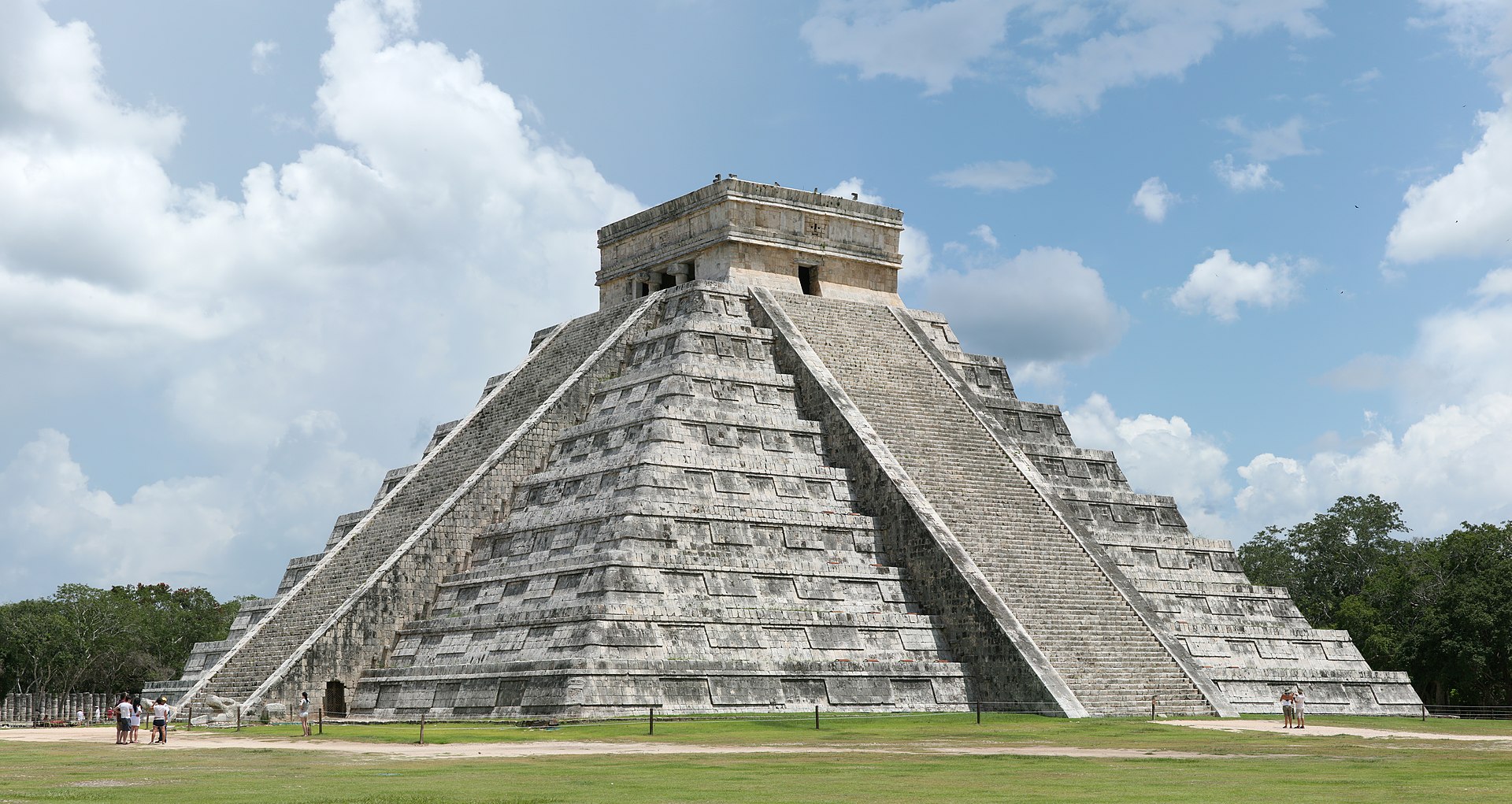
El Castillo (c.900–1100 CE) – 24m nine-step pyramid with 91 steps per stair plus top platform (365), dedicated to Kukulkan feathered serpent.
🇳🇦 Namibia · Rock art
Late Stone Age to early pastoral (6000 BCE – 1000 CE) · San hunter-gatherer (Ju/'hoansi ancestors)
Namibia's sole UNESCO World Heritage site besides Brandberg, Twyfelfontein holds over 2,500 engravings pecked into a 600-m sandstone outcrop of Etjo formation.
🇮🇳 India · Temple complex
Early medieval c.8th c. legend; current 12th–17th c. rebuilds · Himalayan Hindu (Adi Shankara tradition)
Kedarnath – 12 Jyotirlinga at 3,583m on Mandakini headwater below Kedarnath peak (6,940m). Kate stone temple (north-facing with conical lingam and seated Nandi) attributed 8th c.